
Last updated October 30, 2026
The Complete Guide to ADU in Newport Beach
Most Newport Beach homeowners who start ADU research online are reading guides written for Sacramento. That matters more than you’d think. California’s state ADU law gets talked about like it’s a uniform rulebook, but in Newport Beach, state law is the floor, not the ceiling. Our city adds layers most statewide guides never mention: a Local Coastal Program with its own approval process, lot coverage math that varies from street to street, and HOA covenants that can override what Sacramento says you’re allowed to build. This guide walks through the actual decision tree a Newport Beach homeowner faces, from zoning reality-check to move-in day, and you can find more guides & resources in our blog. You’ll learn what the city actually enforces, what each ADU type really costs here, and how to avoid the expensive mistakes that come from following generic California advice in a coastal city like Newport Beach.
Quick Answer
Building an ADU in Newport Beach typically costs $250,000 to $550,000 for a detached unit and $120,000 to $250,000 for a garage conversion, with timelines running 9 to 18 months from design to certificate of occupancy depending on whether you choose prefab, modular, or custom construction. The fastest path is a factory-built unit from a manufacturer already approved by the state, which can shave 4 to 6 months off the process compared to ground-up construction, but your specific lot, HOA, and coastal overlay status determine what’s actually buildable. Newport Beach ADU Builders helps homeowners sort through these variables and match the right construction method to their property.
Table of Contents
- Newport Beach Zoning: What Actually Applies
- The Local Coastal Program Layer Most Guides Skip
- Lot Coverage, Setbacks, and the Numbers That Kill Projects
- ADU Types Compared: Prefab, Modular, Custom, and Garage Conversion
- What an ADU Really Costs in Newport Beach
- The Real Timeline: Permit to Certificate of Occupancy
- HOA Restrictions: What Your CC&Rs Can and Cannot Block
- Common Mistakes to Avoid
- When to Call a Professional
- Frequently Asked Questions
Newport Beach Zoning: What Actually Applies
Newport Beach has its own municipal code, and it does not simply defer to Sacramento. If you live in an R-1 single-family zone, state law says you’re entitled to one ADU and one junior ADU on your lot. Newport Beach honors that entitlement, but the city’s implementation adds conditions: your detached ADU must stay within the maximum height of 16 feet in most zones, unless the lot is within a half-mile of a transit stop or major corridor, in which case 18 feet may apply. Attached ADUs cannot exceed 50% of the primary dwelling’s square footage in Newport Beach’s R-1 zones, and the city caps detached ADUs at 1,000 square feet regardless of lot size, which is stricter than what state law permits in some other jurisdictions.
What surprises many homeowners is how much variation exists within Newport Beach itself. The zoning map is not uniform. Balboa Peninsula lots are often in R-2 or even R-3 zones, where different rules apply. Lido Isle and Linda Isle have their own deed restrictions. West Newport near the Santa Ana River faces different flood zone requirements than Eastbluff or Spyglass Hill. We’ve seen homeowners in Corona del Mar get one answer from the city counter, then watch a neighbor on a different street get a different determination on an identical proposal because the lot was in a different zone or overlay. Before you spend a dollar on plans, pull your specific APN and verify your zone, your coastal overlay status, and your HOA status. The city’s GIS portal shows all three.
ADU Builders in Newport Beach who work in the city every week know which zones get pushback and which move through planning with minimal friction. That knowledge alone can save months.
The Local Coastal Program Layer Most Guides Skip
Newport Beach operates under a certified Local Coastal Program, commonly shortened to LCP. This is the single biggest gap between generic California ADU guides and what actually happens when you apply here. State ADU law says cities must approve ADUs ministerially, without discretionary review, as long as they meet objective standards. Here’s the catch: the California Coastal Act gives the Coastal Commission authority over development in the coastal zone, and Newport Beach’s LCP is the city’s agreement with the Coastal Commission about how that authority gets exercised. In practice, an ADU proposed on a lot within the coastal zone, which covers much of Newport Beach south of Coast Highway and portions of the Balboa Peninsula, may require a coastal development permit in addition to the building permit. That permit has its own review process, its own fees, and in some cases, its own public notice requirements.
This is not a theoretical hurdle. We’ve talked to homeowners who assumed state ADU streamlining would override everything, only to discover their project needed coastal review because the lot was within 100 feet of a wetland or because the ADU would change drainage patterns on a bluff-top parcel in Cameo Shores. The LCP adds 2 to 4 months to the process for affected properties, and it can impose conditions that state law would not otherwise allow, such as reduced height, landscape screening requirements, or restrictions on exterior lighting. For ongoing maintenance considerations after you build, see our Seasonal ADU Care for Newport Beach: Year-Round Homeowner’s Guide.
The practical takeaway: don’t trust a timeline you read on a non-Newport Beach website. Ask your contractor or designer to verify, in writing, whether your specific parcel triggers coastal review. That’s a question we answer for every client before design work begins.
Lot Coverage, Setbacks, and the Numbers That Kill Projects
State law sets maximum setbacks for ADUs at 4 feet from rear and side property lines, but Newport Beach’s municipal code and its LCP overlay can impose stricter requirements in certain neighborhoods. More importantly, the city enforces lot coverage limits that do not go away just because the state wants ADUs to be easy to build. In Newport Beach’s R-1 zones, total lot coverage including the primary home, the ADU, driveways, and any other impervious surfaces typically cannot exceed 40% to 50% of the lot area, depending on the specific zone. On a 5,000-square-foot lot, that means your total footprint budget is roughly 2,000 to 2,500 square feet. If your primary home is already 2,200 square feet and you have a two-car garage and a pool deck, you may have zero room for a detached ADU no matter what state law says.
Here’s the decision tree we walk through with every Newport Beach homeowner:
- Pull your lot square footage and your existing impervious coverage from the city’s parcel viewer.
- Subtract your current footprint from the allowable coverage limit for your zone. That’s your buildable envelope.
- Check your zone’s specific setback requirements, which vary between the Balboa Peninsula, Lido Isle, and the inland hillside neighborhoods.
- If the envelope is too small for a detached ADU, evaluate a garage conversion or an attached ADU, which typically count differently against coverage.
- If you’re in the coastal zone, add the LCP layer before finalizing feasibility.
The lot coverage math kills more ADU projects in Newport Beach than permit fees ever will. A knowledgeable Newport Beach ADU Builders home team can run this analysis before you have plans drawn, because no one should pay an architect to design an ADU that cannot legally fit on the lot.
ADU Types Compared: Prefab, Modular, Custom, and Garage Conversion
The right ADU type for a Newport Beach lot depends on three things: your budget, your patience for construction disruption, and the physical constraints of your site. None of the four common approaches is universally better. They solve different problems.
Factory-Built Prefab (Boxabl, Cover)
Prefab units are built in a factory, shipped to the site, and set on a prepared foundation. In Newport Beach, this approach works well on lots with street access to the rear yard or side yard, which is not as common here as it is in newer Orange County developments. Older neighborhoods like the Balboa Peninsula and parts of Corona del Mar have narrow streets, tight alleys, and overhead utility lines that make crane delivery complicated or impossible. When the site works, factory-built speed is real: a Boxabl unit can be installed in a day on a previously permitted foundation, and a Cover unit arrives as a completed structure with finishes installed. The tradeoff is design flexibility. You are choosing from a catalog, not designing a custom home.
Panelized and Modular (Mighty Buildings, Dvele)
Panelized construction falls between prefab and custom. These manufacturers produce wall, floor, and roof panels in a controlled factory, then assemble them on site. Mighty Buildings uses a composite stone material that cuts framing time significantly. Dvele builds full modular units with interior finishes completed before delivery. In Newport Beach, these approaches make sense for lots where full prefab delivery won’t work but where you still want factory quality control and reduced on-site construction time. The limitation is that panelized and modular systems still require on-site assembly labor, which brings you back into the city’s inspection cycle for framing, rough electrical, and rough plumbing. You save time and weather exposure, but you don’t escape the building department queue entirely.
Custom Ground-Up Construction
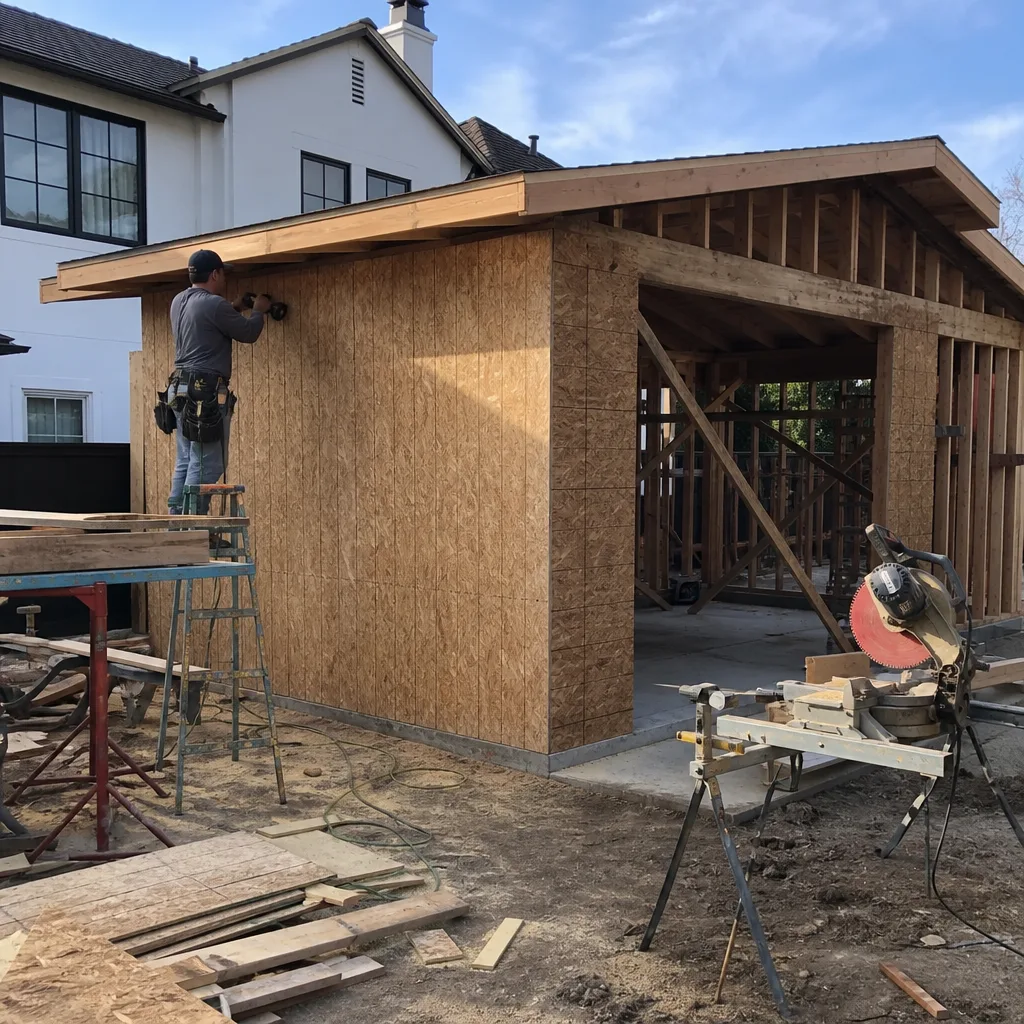
Custom ADUs dominate in Newport Beach’s hillside neighborhoods and on lots with irregular shapes, steep slopes, or view corridor restrictions. A custom build gives you exact control over footprint, height, and exterior materials, which matters when you’re preserving a view corridor from Spyglass Hill or matching a Spanish Revival primary home in the Flower Streets. Custom is the most expensive path, both in dollars and in time, but on complicated lots it may be the only path that actually works.
Garage Conversion
Garage conversions are the quiet workhorse of Newport Beach ADUs. They use existing square footage, which sidesteps lot coverage limits entirely. They preserve yard space. They usually avoid the coastal review process because they don’t create new impervious surface. The downside is that you lose covered parking, and in some Newport Beach neighborhoods, street parking is scarce enough that losing a garage is a real lifestyle cost. State law prohibits the city from requiring replacement parking for ADU conversions, but that doesn’t solve the practical problem of a household with two cars and no garage on a street where parking is already tight. Converting an existing garage in Newport Beach typically costs $120,000 to $250,000 depending on the condition of the slab, the framing, and the scope of kitchen and bathroom work inside the converted space.
Our position as a brand-agnostic contractor means we don’t have a favorite among these approaches. We’ve watched homeowners buy into a specific manufacturer’s sales pitch before doing a site assessment, then discover the product doesn’t fit their lot or their HOA. The build decision should be made after a site assessment. Never before.
What an ADU Really Costs in Newport Beach
National and state ADU cost guides will tell you $150,000 to $300,000. That’s optimistic for Newport Beach. Our city’s costs run higher for three reasons: coastal foundation requirements, architectural review in some neighborhoods, and the simple fact that Newport Beach labor rates track with Orange County’s top-tier market. Here’s the line-item reality based on projects we’ve seen in the city.
Detached ADU Cost Ranges in Newport Beach
- Garage conversion (400-600 sq ft): $120,000 to $250,000
- Prefab detached unit (400-800 sq ft, Boxabl or similar): $180,000 to $320,000 including foundation and site work
- Panelized or modular detached (600-1,000 sq ft, Mighty Buildings or Dvele): $280,000 to $480,000
- Custom ground-up detached (600-1,000 sq ft): $350,000 to $550,000 and up, depending on site conditions and finishes
What drives the spread within each range? Foundation type. A standard slab on grade is the cheapest option, but many Newport Beach lots, particularly near the bay, require raised foundations, deep piers, or special corrosion-resistant materials. A lot near the water in Lido Isle or on the peninsula may need a foundation that costs two to three times what a slab costs on an inland lot in Westcliff. Flood zone proximity also triggers elevation requirements and higher insurance. If your lot sits in an AE flood zone, your ADU’s finished floor may need to be a foot or more above base flood elevation, which changes both the foundation design and the unit’s look from the street.
Permit fees in Newport Beach add another $8,000 to $25,000 depending on project scope and whether coastal review applies. School district fees, which Sacramento exempts small ADUs from paying but larger units may still trigger, add somewhere between $4,000 and $12,000 if your ADU exceeds 750 square feet. Architectural review fees in neighborhoods with design guidelines add another $2,000 to $6,000.
For a complete picture of what applies to your specific address, a Newport Beach ADU builder can provide a written cost estimate after a site visit. Estimates should be free and should be line-item detailed, not a single number.
The Real Timeline: Permit to Certificate of Occupancy
State law requires cities to act on ADU applications within 60 days, but “acting” is not the same as “approving.” Newport Beach’s building department, like every building department in coastal Southern California, has a queue. Here’s the timeline we tell clients to expect in 2024 and 2025.
- Site assessment and feasibility: 2 to 4 weeks. You cannot skip this step. It’s where you discover lot coverage problems, coastal triggers, and HOA issues before you pay for plans.
- Design and plans: 4 to 10 weeks. Prefab manufacturers deliver their own plans faster than custom designers. If you’re doing a garage conversion, plan review is simpler and faster.
- City plan review and coastal review (if applicable): 6 to 16 weeks. Coastal review adds 6 to 10 weeks on top of standard plan check. This is the variable that breaks most generic timelines from state ADU advocates.
- Permit issuance: 2 to 4 weeks after plan approval, assuming no corrections are required.
- Construction: The big variable. A Boxabl unit goes from foundation-ready to move-in in 4 to 8 weeks. A panelized Mighty Buildings ADU takes 12 to 20 weeks on site. A custom build runs 20 to 40 weeks depending on site conditions and weather.
- Final inspection and certificate of occupancy: 1 to 2 weeks if everything passes on first inspection.
Realistic total, assuming no coastal review and a standard prefab or conversion: 9 to 12 months. Custom build with coastal review: 14 to 18 months. Anyone promising a 6-month ADU in Newport Beach is not accounting for this city’s actual process. If your main goal is rental income, every month of delay is revenue you’re not collecting, which changes the math on your project. A prefab unit that costs $30,000 more upfront but rents out four months sooner recovers that difference quickly at Newport Beach rental rates.
HOA Restrictions: What Your CC&Rs Can and Cannot Block
Newport Beach has a high concentration of HOA-governed communities: Lido Isle, Linda Isle, Big Canyon, One Ford Road, and the newer developments around Newport Coast, which falls under Newport Beach’s sphere. State ADU law limits what HOAs can prohibit, but it does not eliminate HOA authority. An HOA cannot ban ADUs outright. It can, however, impose architectural standards, placement restrictions, and sometimes rental restrictions that affect your project’s economics.
The most common HOA friction point in Newport Beach is rental restrictions. Some associations limit rentals to 30-day minimums or prohibit short-term rentals entirely. If your ADU plan depends on Airbnb income, and your HOA prohibits rentals under 30 days, your project may still be legal to build but not profitable to operate the way you intended. We’ve seen this specific disappointment multiple times. Read your CC&Rs before you build, not after.
Another pattern we see in Newport Beach HOA communities: height and view corridor restrictions that are stricter than city code. An HOA that protects ocean views from upper balconies may require your detached ADU to stay under 12 feet even though the city would allow 16. The city will not override a private covenant. Your HOA board, not the building department, is the enforcer in these situations. This is another reason the site assessment comes before the build decision. If your HOA will only allow a 10-foot structure, a two-story Dvele unit is irrelevant to you.
Common Mistakes to Avoid
- Believing state law overrides everything. State ADU law is powerful, but it does not override the Coastal Act, HOA covenants, or Newport Beach’s lot coverage limits. The state sets a floor; the city and your HOA set the actual ceiling.
- Choosing a builder before choosing a site strategy. A manufacturer’s sales process starts with a product. Your project should start with a site assessment. The order matters because the product that fits your lot may not be the one whose website you found first.
- Underestimating foundation costs on coastal lots. If you’re near the bay or in a flood zone, your foundation could be the single most expensive line item on the entire project. Get elevation and soil data before you budget.
- Ignoring the rental restrictions in your HOA. A buildable ADU that cannot be rented is a multi-hundred-thousand-dollar guest house. That may still be worth it for family use, but it’s a different financial decision.
- Converting a garage without solving parking. You may not be legally required to replace the parking, but if your household has three cars and your street has no overnight parking, you’ve created a daily stressor that will wear on you more than you expect.
- Planning for a crane delivery on a street that won’t accommodate one. Some of Newport Beach’s older neighborhoods have streets too narrow for a crane and utility lines too low for a delivery truck. Verify delivery feasibility before committing to a prefab order.
- Basing your budget on a non-coastal California cost guide. Newport Beach prices are real. If your budget was built around an inland estimate, you’re underfunded before you start.
When to Call a Professional
You should bring in a professional before you spend money on plans, not after. If you suspect your lot is in the coastal zone, if your HOA has restrictive covenants, if your lot coverage math looks tight, or if you’re weighing prefab against custom and don’t know how to compare them fairly, that’s the moment to get an experienced assessment. A contractor who works across manufacturers and build types can tell you which approach actually fits your property rather than pushing the one product they’re authorized to sell. Newport Beach ADU Builders offers free estimates in Newport Beach, including a site assessment that covers zoning, coverage, HOA review, and cost comparison across multiple construction methods. Call (844) 934-0236 to schedule yours.
Frequently Asked Questions
Expect $120,000 to $550,000 depending on ADU type and site conditions, with detached custom units at the high end and garage conversions at the low end. Coastal foundation requirements, HOA architectural standards, and the scope of interior finish work are the biggest cost variables. Call (844) 934-0236 for an exact quote after a site visit, estimates are free.
Plan on 9 to 14 months from application to permit issuance if coastal review applies, and 4 to 8 months without it. Newport Beach’s Local Coastal Program adds an approval layer that many state-level timelines don’t account for.
No, California state law prohibits HOAs from banning ADUs outright, but your HOA can restrict placement, height, exterior appearance, and in some cases rental terms. Read your CC&Rs before you design.
Usually yes for the structure itself, but site costs matter. A prefab unit still needs a foundation, utility connections, and in some cases a crane. On a difficult coastal lot, those site costs can narrow or erase the price gap, and custom may be the only feasible option.
In most cases yes, but short-term rentals are restricted in many parts of the city and by many HOAs. Long-term rentals of 30 days or more are broadly permitted for ADUs built after 2020, but verify your specific HOA rules and city rental regulations before counting on rental income.
If your lot is within the coastal zone, likely yes, especially if the project creates new impervious surface or affects drainage. Non-coastal lots and many garage conversions avoid this layer. Your contractor can verify your property’s status before design begins.
It shouldn’t, not if the initial estimate was based on a thorough site assessment. The change orders that blow up ADU budgets almost always trace back to site conditions that were never investigated, like soil problems discovered after excavation or HOA requirements discovered after plans were drawn. A fixed-price contract based on a complete site assessment is achievable, and that’s what we aim for on every project. Call (844) 934-0236 to get a line-item quote.
The Bottom Line
Building an ADU in Newport Beach is a site-by-site negotiation between state law, city code, coastal regulation, and private covenants. The homeowners who get it right start with a site assessment and let the lot, the HOA, and the coastal overlay determine what gets built, rather than falling in love with a product or a price before understanding the property. The cost range is wide because the variable is wide: your specific street, zone, and association matter more than any generic guide. Work with a contractor who knows this city, who can compare prefab against custom honestly, and who can handle the interior finish work so the ADU is turnkey when it’s done. That approach costs less in time and money than discovering the problems late. Kitchen remodeling in Newport Beach and bathroom remodeling in Newport Beach under the same contractor relationship mean the ADU interior doesn’t require a second company, a second schedule, or a second bid. For a free site assessment and written estimate, call (844) 934-0236.
Written by the team at Newport Beach ADU Builders, serving Newport Beach since 2016.